In This Article
Introduction: What Are Scientific Names of Animals?
Every animal on Earth — from the lion prowling the African savanna to the monarch butterfly drifting across North America — has two names: the common name most of us use every day, and a scientific name that is the same in every language, every country, and every century.
Having a name for something allows us to talk about it — but everyday names for animals can be imprecise and vary between people and languages. This problem was solved in 1753 by Carl Linnaeus, a practical Swedish biologist who gave each species a two-word name made up of a genus name and a specific name — for example, Homo sapiens for modern humans. The method soon caught on and is still used by scientists today.
Scientific names of animals are used by biologists, zoologists, conservationists, and students worldwide. They appear in textbooks, research papers, wildlife documentaries, and competitive exams — and understanding how they work makes the natural world significantly easier to study and remember.
What Is Binomial Nomenclature?
Binomial nomenclature is a formal way to name species using two names usually derived from Latin, though they can come from other languages too. This two-part name highlights the genus and species of an organism. The first part tells us the genus, and the second part specifies the exact species.
Scientific names or binomial nomenclature is a scientific process wherein entities such as plants, animals, and living entities are named — derived from Latin. It has many advantages including classification and organisation (entities are comprehensively organised which makes understanding characteristics easy), precision and clarity (each species is given one unique scientific name, hence avoiding confusion), and universal recognition — the scientific names are standardised worldwide.
The Two Parts of a Scientific Name
| Part | What It Represents | Example |
|---|---|---|
| Genus (first word) | The broader group the animal belongs to | Panthera |
| Species (second word) | The specific animal within that genus | leo |
| Full scientific name | Genus + Species together | Panthera leo (Lion) |
Rules for Writing Scientific Names
If you include the taxonomic rank (e.g., species, genus) in your writing, do not capitalize or italicize these terms — they are considered common nouns. Once you have written the full scientific name, you can abbreviate the genus name to its initial letter if you mention the species again — e.g., H. sapiens after writing Homo sapiens in full. If a scientific name appears in a title or at the beginning of a sentence, use the full name even if it has been abbreviated previously in the text.
In summary:
- The genus name is always capitalized — Panthera
- The species name is always lowercase — leo
- Both are written in italics when typed — Panthera leo
- Both are underlined when handwritten — Panthera leo
What Is a Trinomen?
Trinomen is the trinomial name given to animals apart from the genus name and the species name. It is usually given to identify a subspecies. For example, the trinomen of the grey wolf subspecies, the Arctic wolf, is Canis lupus arctos. Modern humans have been given the trinomial designation as Homo sapiens sapiens.
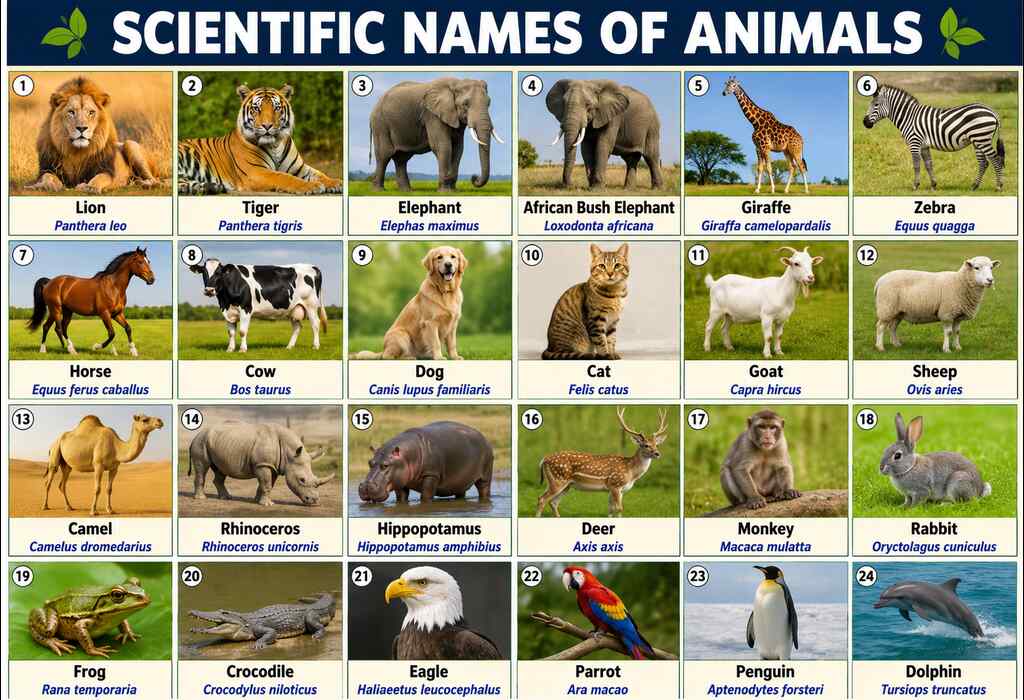
Scientific Names of Common Animals
🦁 Wild Animals
| Common Name | Scientific Name |
|---|---|
| Lion | Panthera leo |
| Tiger | Panthera tigris |
| Leopard | Panthera pardus |
| Cheetah | Acinonyx jubatus |
| Snow Leopard | Panthera uncia |
| Wolf (Grey Wolf) | Canis lupus |
| African Wild Dog | Lycaon pictus |
| Elephant (African) | Loxodonta africana |
| Elephant (Asian) | Elephas maximus |
| Rhinoceros | Rhinoceros unicornis |
| Hippopotamus | Hippopotamus amphibius |
| Giraffe | Giraffa camelopardalis |
| Zebra | Equus quagga |
| Polar Bear | Ursus maritimus |
| Brown Bear | Ursus arctos |
| Giant Panda | Ailuropoda melanoleuca |
| Gorilla | Gorilla gorilla |
| Chimpanzee | Pan troglodytes |
| Orangutan | Pongo pygmaeus |
| Jaguar | Panthera onca |
🐄 Domestic Animals
| Common Name | Scientific Name |
|---|---|
| Dog | Canis lupus familiaris |
| Cat | Felis catus |
| Cow | Bos taurus |
| Horse | Equus caballus |
| Donkey | Equus asinus |
| Sheep | Ovis aries |
| Goat | Capra hircus |
| Pig | Sus scrofa domesticus |
| Rabbit | Oryctolagus cuniculus |
| Chicken | Gallus gallus domesticus |
| Buffalo | Bubalus bubalis |
| Camel | Camelus dromedarius |
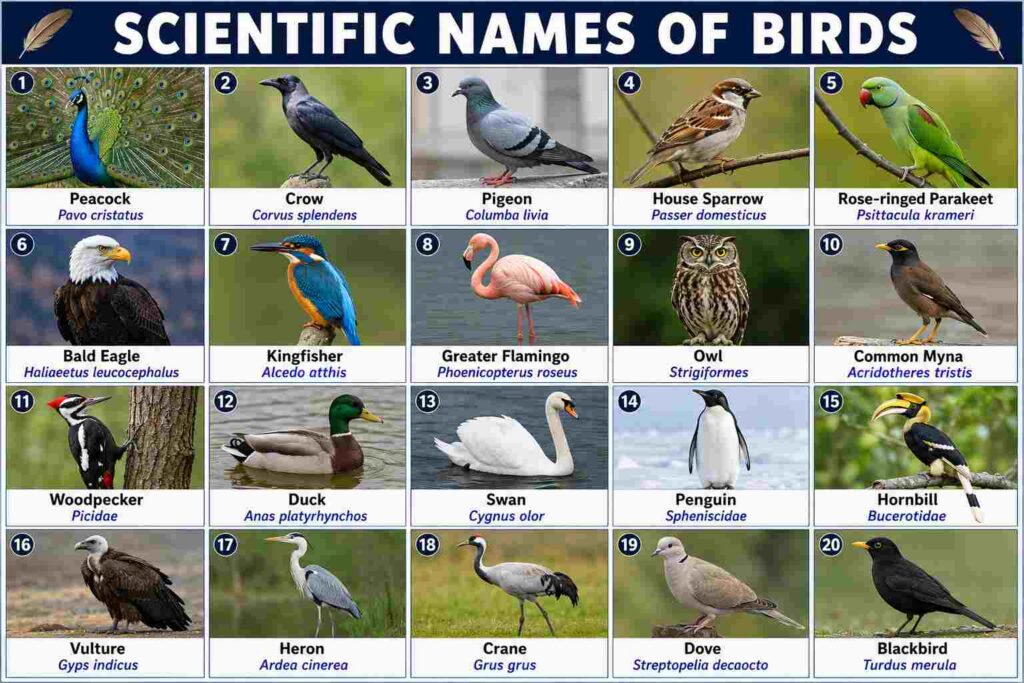
🐦 Birds
| Common Name | Scientific Name |
|---|---|
| House Sparrow | Passer domesticus |
| Peacock | Pavo cristatus |
| Crow | Corvus splendens |
| Pigeon | Columba livia |
| Eagle (Bald) | Haliaeetus leucocephalus |
| Owl (Barn) | Tyto alba |
| Parrot (African Grey) | Psittacus erithacus |
| Flamingo | Phoenicopterus roseus |
| Penguin (Emperor) | Aptenodytes forsteri |
| Ostrich | Struthio camelus |
| Kingfisher | Alcedo atthis |
| Vulture (Griffon) | Gyps fulvus |
| Swan | Cygnus olor |
🐟 Aquatic Animals
| Common Name | Scientific Name |
|---|---|
| Great White Shark | Carcharodon carcharias |
| Blue Whale | Balaenoptera musculus |
| Bottlenose Dolphin | Tursiops truncatus |
| Clownfish | Amphiprion ocellaris |
| Octopus | Octopus vulgaris |
| Sea Horse | Hippocampus kuda |
| Nile Crocodile | Crocodylus niloticus |
| Sea Turtle (Green) | Chelonia mydas |
| Salmon (Atlantic) | Salmo salar |
| Goldfish | Carassius auratus |
| Starfish | Asterias rubens |
| Jellyfish (Moon) | Aurelia aurita |
🐍 Reptiles & Amphibians
| Common Name | Scientific Name |
|---|---|
| King Cobra | Ophiophagus hannah |
| Indian Python | Python molurus |
| Komodo Dragon | Varanus komodoensis |
| Chameleon | Chamaeleo chamaeleon |
| Gecko (Common) | Gekko gecko |
| Indian Bullfrog | Hoplobatrachus tigerinus |
| Tree Frog | Hyla arborea |
| Salamander | Salamandra salamandra |
🦋 Insects & Invertebrates
| Common Name | Scientific Name |
|---|---|
| Monarch Butterfly | Danaus plexippus |
| Honeybee | Apis mellifera |
| Housefly | Musca domestica |
| Mosquito | Anopheles gambiae |
| Silk Moth | Bombyx mori |
| Ladybird | Coccinella septempunctata |
| Dragonfly | Anax junius |
| Firefly | Photinus pyralis |
| Cockroach | Periplaneta americana |
🐨 Indian & Endangered Animals
| Common Name | Scientific Name |
|---|---|
| Bengal Tiger | Panthera tigris tigris |
| Indian Lion | Panthera leo persica |
| Indian Elephant | Elephas maximus indicus |
| Indian Rhinoceros | Rhinoceros unicornis |
| Snow Leopard | Panthera uncia |
| Indian Peacock | Pavo cristatus |
| Great Indian Bustard | Ardeotis nigriceps |
| Gangetic Dolphin | Platanista gangetica |
| Indian Cobra | Naja naja |
| Red Panda | Ailurus fulgens |
| Indian Pangolin | Manis crassicaudata |
| Nilgiri Tahr | Nilgiritragus hylocrius |
How the Scientific Naming System Works
Linnaeus’ system is now governed by a set of rules produced by the International Commission on Zoological Nomenclature. The rules ensure that the same scientific name can be used for the same animal by all scientists across the world, meaning scientists can confidently and precisely communicate with each other about animals. New species are described in a particular way, published in a scientific paper, with a description and illustrations.
The 7-Level Classification Hierarchy
Every scientific name sits within a broader classification system:
| Level | Example (Lion) |
|---|---|
| Kingdom | Animalia |
| Phylum | Chordata |
| Class | Mammalia |
| Order | Carnivora |
| Family | Felidae |
| Genus | Panthera |
| Species | leo |
| Full Name | Panthera leo |
Why Are Scientific Names Important?
Scientific names of animals serve as global languages, transcending linguistic barriers and allowing scientists and enthusiasts worldwide to identify and study creatures accurately. These scientific names are also important for understanding animals and providing information about their family tree.
The four key reasons scientific names matter:
- Universal communication — A biologist in Japan and a researcher in Brazil both know exactly which animal Panthera tigris refers to, regardless of language
- Precision — Common names are unreliable: “Robin” refers to different bird species in the UK and the USA; Erithacus rubecula is always the European robin
- Classification insight — The genus name reveals relationships: Panthera leo (lion), Panthera tigris (tiger), and Panthera pardus (leopard) are clearly revealed as close relatives
- Stability across time — Even if species are transferred to another genus on the basis of new knowledge, the names are retained, preserving centuries of scientific literature
Scientific Names for Competitive Exams — Quick Reference
A commonly tested list across UPSC, SSC, NDA, CDS, and school biology exams:
| Common Name | Scientific Name |
|---|---|
| Human | Homo sapiens |
| Lion | Panthera leo |
| Tiger | Panthera tigris |
| Dog | Canis lupus familiaris |
| Cat | Felis catus |
| Cow | Bos taurus |
| Horse | Equus caballus |
| Elephant | Elephas maximus |
| Peacock | Pavo cristatus |
| Crow | Corvus splendens |
| House Sparrow | Passer domesticus |
| Honeybee | Apis mellifera |
| Housefly | Musca domestica |
| Silk Moth | Bombyx mori |
| King Cobra | Ophiophagus hannah |
| Indian Cobra | Naja naja |
| Frog | Hoplobatrachus tigerinus |
| Mosquito | Anopheles gambiae |
| Pigeon | Columba livia |
| Rabbit | Oryctolagus cuniculus |
Frequently Asked Questions
1. What is the scientific name of animals called?
The scientific name of an animal is called its binomial name or Latin name — derived from the binomial nomenclature system. It consists of two parts: the genus (capitalized) and the species (lowercase), both written in italics — for example, Panthera leo for the lion.
2. Who invented the scientific naming system for animals?
The scientific naming system was invented by Carl Linnaeus, a practical Swedish biologist, who in 1753 gave each species a two-word name made up of a genus name and a specific name. The method soon caught on and is still used by scientists today.
3. What is the scientific name of a human?
The scientific name of a human being is Homo sapiens, meaning “wise man” in Latin. The full trinomial name for modern humans is Homo sapiens sapiens, distinguishing modern humans from archaic subspecies.
4. What is the scientific name of a lion?
The scientific name of a lion is Panthera leo. Panthera is the genus that includes all big cats (tiger, leopard, jaguar, snow leopard), and leo comes from the Latin word for lion.
5. What is the scientific name of a dog?
The scientific name of a domestic dog is Canis lupus familiaris. This trinomial name indicates the dog is a domesticated subspecies of the grey wolf (Canis lupus), confirming the evolutionary relationship between dogs and wolves.
6. Why are scientific names written in Latin?
Scientific names are written in Latin primarily for historical reasons — Latin was the universal language of science and scholarship in Europe during the 17th and 18th centuries when the naming system was established. Latin also has the advantage of being a dead language, meaning its meanings stay fixed and cannot drift over time the way living languages do.
7. What is the difference between genus and species in a scientific name?
The genus is the broader group of closely related animals — for example, Panthera includes lions, tigers, leopards, and jaguars. The species is the specific type of animal within that genus — leo for the lion only. Together, genus + species = the unique scientific name for exactly one animal species on Earth.
8. What is the scientific name of a tiger?
The scientific name of a tiger is Panthera tigris. The Bengal tiger — found in India and Bangladesh — has the trinomial name Panthera tigris tigris, confirming it is a subspecies of the tiger.
9. How do you write a scientific name correctly?
Always write the genus name with a capital first letter and the species name entirely in lowercase. Both parts should be in italics when typed (Panthera leo) or underlined when written by hand. After first use, the genus name may be abbreviated to its initial letter — P. leo.
10. What is a trinomen in animal scientific names?
A trinomen is the trinomial name given to animals to identify a subspecies, consisting of three parts — genus, species, and subspecies. For example, the Arctic wolf’s trinomen is Canis lupus arctos, identifying it as a subspecies of the grey wolf (Canis lupus).
Scientific names of animals are far more than a list of Latin words to memorise for exams — they are a 270-year-old universal language that connects every biologist, naturalist, conservationist, and student on Earth through a shared, precise code for life.
Once you understand the system — genus identifies the family, species identifies the individual, italics signal the scientific name — reading and remembering these names becomes significantly easier. The lion is always Panthera leo, the honeybee is always Apis mellifera, and the human is always Homo sapiens, in every language, in every country, in every century.