
In This Article
Scientific names of plants are two-part botanical names assigned to every plant species using the binomial nomenclature system first published by Carl Linnaeus in Species Plantarum (1753) — enabling botanists, students, and gardeners worldwide to identify plants with precision across all languages.
What Are Scientific Names of Plants?
Every plant on Earth — from the sacred Tulsi in an Indian courtyard to the towering Giant Sequoia of California — carries two names: the common name used in everyday conversation and a scientific name that is universally recognised in every language, country, and century.
Scientific names of plants, referred to as botanical names or binomial nomenclature, are vital for systematically classifying and identifying plants — two-part names that include a genus and a species, often Latin-based, designed to prevent confusion and enhance understanding of organism characteristics.
Common names of plants often vary from region to region — for example, the Red Maple is commonly called the Scarlet or Swamp Maple in some areas — which is exactly why scientific names provide an essential universal standard. A botanist in India and a researcher in Brazil both know exactly which plant Rosa chinensis refers to, regardless of what they call it locally.
Since the first printing of Carl Linnaeus’s Species Plantarum in 1753, plants have been assigned one epithet or name for their species and one name for their genus — a grouping of related species.
What Is Plant Binomial Nomenclature?
Scientific names of plants, also known as binomial nomenclature, are assigned to all living organisms including plants, animals, birds, and flowers. These names, often Latin-based, consist of two parts: the genus and the specific epithet. Their purpose is to prevent confusion and enhance understanding of organism characteristics.
The red maple is in the “maple” genus, which is called Acer, and its specific epithet is rubrum, which is Latin for red. Therefore, the binomial name for this species is Acer rubrum.
The Two Parts of a Plant Scientific Name
| Part | What It Represents | Example |
|---|---|---|
| Genus (first word) | The broader group of related plants | Rosa |
| Species (second word) | The specific plant within that genus | chinensis |
| Full botanical name | Genus + Species together | Rosa chinensis (Chinese Rose) |
Rules for Writing Plant Scientific Names
- The genus name always begins with a capital letter — Rosa
- The species name is always lowercase — chinensis
- Both parts are written in italics when typed — Rosa chinensis
- Both parts are underlined when written by hand — <u>Rosa chinensis</u>
- A genus may contain a single species (e.g., Ginkgo) or more than 100 (e.g., Rosa).
- After first mention, the genus can be abbreviated — R. chinensis
- The cultivar name (for garden varieties) is added in single quotes — Rosa chinensis ‘Minima’
Why Are Scientific Names of Plants Important?
Scientific names have many advantages — classification and organisation (entities are comprehensively organised which makes understanding and studying characteristics easy and organised), precision and clarity (each species is given one unique scientific name hence avoiding confusion), and the scientific names are universally recognised and standardised. Even if species are transferred to another genus on the basis of new knowledge, the names are retained. It helps understand the similarities and differences between various species that belong to the same genera, helpful in building associations between them.
The four core reasons plant scientific names matter:
- Universal communication — Ocimum tenuiflorum is Tulsi in India, Holy Basil in the West, and Krapao in Thailand — one name eliminates all confusion
- Reveals relationships — Solanum lycopersicum (tomato) and Solanum melongena (brinjal) share a genus, immediately showing they are botanical relatives
- Prevents dangerous errors — In medicine and horticulture, mistaken plant identity can be harmful; scientific names ensure precise identification
- Stable across centuries — The World Flora Online Plant List provides the accepted scientific name for all taxa with links to all synonyms by which a taxon has been known — preserving centuries of botanical knowledge in one standardised system.
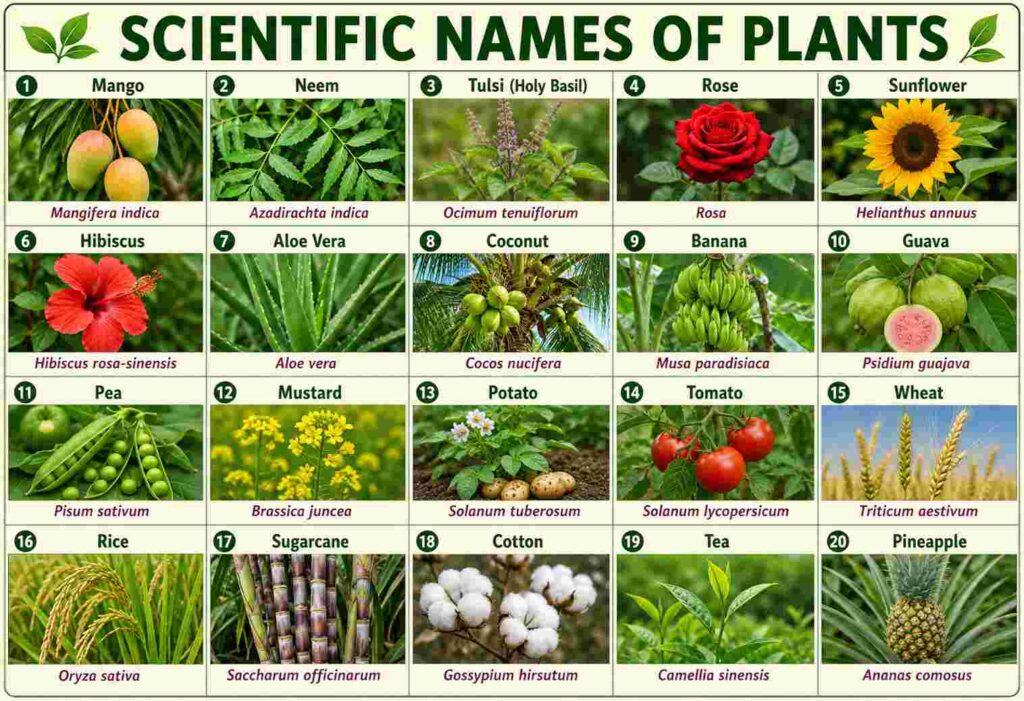
Scientific Names of Common Plants
🌸 Flowers & Garden Plants
| Common Name | Scientific Name |
|---|---|
| Rose | Rosa indica |
| Chinese Rose | Rosa chinensis |
| Lotus | Nelumbo nucifera |
| Sunflower | Helianthus annuus |
| Marigold | Tagetes erecta |
| Jasmine | Jasminum officinale |
| Hibiscus | Hibiscus rosa-sinensis |
| Tulip | Tulipa gesneriana |
| Lily | Lilium candidum |
| Orchid | Orchis mascula |
| Dahlia | Dahlia pinnata |
| Chrysanthemum | Chrysanthemum indicum |
| Lavender | Lavandula angustifolia |
| Peony | Paeonia officinalis |
| Bougainvillea | Bougainvillea spectabilis |
| Night Jasmine (Parijat) | Nyctanthes arbor-tristis |
🌿 Medicinal & Sacred Plants (India)
| Common Name | Scientific Name | Meaning of Name |
|---|---|---|
| Tulsi (Holy Basil) | Ocimum tenuiflorum | tenuiflorum = slender-flowered (Latin) |
| Neem | Azadirachta indica | indica = from India (Latin) |
| Aloe Vera | Aloe barbadensis | barbadensis = from Barbados (Latin) |
| Ashwagandha | Withania somnifera | somnifera = sleep-inducing (Latin) |
| Turmeric | Curcuma longa | longa = long (Latin) |
| Ginger | Zingiber officinale | officinale = used medicinally (Latin) |
| Brahmi | Bacopa monnieri | Named after botanist P. A. Monnier |
| Giloy (Guduchi) | Tinospora cordifolia | cordifolia = heart-leaved (Latin) |
| Amla (Indian Gooseberry) | Phyllanthus emblica | emblica = from Arabic amlaj |
| Shatavari | Asparagus racemosus | racemosus = cluster-flowered (Latin) |
| Sandalwood | Santalum album | album = white (Latin) |
| Indian Camphor | Cinnamomum camphora | camphora = camphor (Arabic origin) |
| Moringa (Drumstick Tree) | Moringa oleifera | oleifera = oil-bearing (Latin) |
| Black Pepper | Piper nigrum | nigrum = black (Latin) |
| Cardamom | Elettaria cardamomum | cardamomum = from Greek kardamomon |
🍎 Fruit Plants
| Common Name | Scientific Name | Meaning of Name |
|---|---|---|
| Mango | Mangifera indica | indica = from India; Mangifera = mango-bearer (Latin) |
| Banana | Musa paradisiaca | paradisiaca = paradise (Latin) |
| Apple | Malus domestica | domestica = cultivated/domesticated (Latin) |
| Orange | Citrus sinensis | sinensis = from China (Latin) |
| Lemon | Citrus limon | limon = lemon (Arabic origin) |
| Grapes | Vitis vinifera | vinifera = wine-bearing (Latin) |
| Guava | Psidium guajava | guajava = from native Arawak name |
| Papaya | Carica papaya | papaya = from native Carib name |
| Pomegranate | Punica granatum | granatum = many-seeded (Latin) |
| Pineapple | Ananas comosus | comosus = tufted (Latin) |
| Coconut | Cocos nucifera | nucifera = nut-bearing (Latin) |
| Jackfruit | Artocarpus heterophyllus | heterophyllus = varied leaves (Greek) |
| Strawberry | Fragaria × ananassa | Fragaria = fragrant (Latin) |
| Watermelon | Citrullus lanatus | lanatus = woolly (Latin) |
| Custard Apple | Annona squamosa | squamosa = scaly (Latin) |
| Litchi | Litchi chinensis | chinensis = from China (Latin) |
🥦 Vegetable Plants
| Common Name | Scientific Name | Meaning of Name |
|---|---|---|
| Tomato | Solanum lycopersicum | lycopersicum = wolf-peach (Greek) |
| Potato | Solanum tuberosum | tuberosum = tuberous (Latin) |
| Onion | Allium cepa | cepa = onion (Latin) |
| Garlic | Allium sativum | sativum = cultivated (Latin) |
| Brinjal / Eggplant | Solanum melongena | melongena = eggplant (Arabic origin) |
| Cabbage | Brassica oleracea | oleracea = of the vegetable garden (Latin) |
| Cauliflower | Brassica oleracea var. botrytis | botrytis = cluster (Greek) |
| Spinach | Spinacia oleracea | oleracea = vegetable garden (Latin) |
| Carrot | Daucus carota | carota = carrot (Greek) |
| Bitter Gourd | Momordica charantia | charantia = a type of melon (Greek) |
| Bottle Gourd | Lagenaria siceraria | siceraria = of a gourd (Latin) |
| Pumpkin | Cucurbita maxima | maxima = largest (Latin) |
| Chilli | Capsicum annuum | annuum = annual (Latin) |
| Lady’s Finger / Okra | Abelmoschus esculentus | esculentus = edible (Latin) |
| Pea | Pisum sativum | sativum = cultivated (Latin) |
| Fenugreek | Trigonella foenum-graecum | foenum-graecum = Greek hay (Latin) |
🌳 Trees
| Common Name | Scientific Name | Meaning of Name |
|---|---|---|
| Banyan Tree | Ficus benghalensis | benghalensis = from Bengal (Latin) |
| Peepal Tree | Ficus religiosa | religiosa = religious/sacred (Latin) |
| Teak | Tectona grandis | grandis = large (Latin) |
| Bamboo | Bambusa vulgaris | vulgaris = common (Latin) |
| Eucalyptus | Eucalyptus globulus | globulus = small globe (Latin) |
| Ashoka Tree | Saraca asoca | asoca = without sorrow (Sanskrit) |
| Gulmohar | Delonix regia | regia = royal (Latin) |
| Tamarind | Tamarindus indica | indica = from India (Latin) |
| Giant Sequoia | Sequoiadendron giganteum | giganteum = gigantic (Latin) |
| Oak | Quercus robur | robur = strength (Latin) |
| Pine | Pinus sylvestris | sylvestris = of the forest (Latin) |
| Red Maple | Acer rubrum | rubrum = red (Latin) |
| Mango Tree | Mangifera indica | indica = from India (Latin) |
| Neem Tree | Azadirachta indica | indica = from India (Latin) |
| Ginkgo | Ginkgo biloba | biloba = two-lobed (Latin) |
🌾 Crop & Grain Plants
| Common Name | Scientific Name | Meaning of Name |
|---|---|---|
| Wheat | Triticum aestivum | aestivum = of summer (Latin) |
| Rice | Oryza sativa | sativa = cultivated (Latin) |
| Maize / Corn | Zea mays | mays = from native American name |
| Sugarcane | Saccharum officinarum | officinarum = of the dispensary (Latin) |
| Cotton | Gossypium hirsutum | hirsutum = hairy (Latin) |
| Jute | Corchorus olitorius | olitorius = of the kitchen garden (Latin) |
| Tea | Camellia sinensis | sinensis = from China (Latin) |
| Coffee | Coffea arabica | arabica = from Arabia (Latin) |
| Soybean | Glycine max | max = large (Latin) |
| Sunflower (oil crop) | Helianthus annuus | annuus = annual (Latin) |
| Mustard | Brassica nigra | nigra = black (Latin) |
| Sorghum | Sorghum bicolor | bicolor = two-coloured (Latin) |
🌱 Common Houseplants
| Common Name | Scientific Name | Meaning of Name |
|---|---|---|
| Money Plant | Epipremnum aureum | aureum = golden (Latin) |
| Snake Plant | Sansevieria trifasciata | trifasciata = three-banded (Latin) |
| Peace Lily | Spathiphyllum wallisii | Named after plant collector Gustav Wallis |
| Spider Plant | Chlorophytum comosum | comosum = tufted (Latin) |
| Rubber Plant | Ficus elastica | elastica = elastic (Latin) |
| Jade Plant | Crassula ovata | ovata = egg-shaped (Latin) |
| Pothos | Epipremnum pinnatum | pinnatum = feather-like (Latin) |
| ZZ Plant | Zamioculcas zamiifolia | zamiifolia = zamia-leaved (Latin) |
| Aloe Vera | Aloe barbadensis | barbadensis = from Barbados (Latin) |
| Chinese Evergreen | Aglaonema commutatum | commutatum = changed/varied (Latin) |
Plant Classification Hierarchy — Worked Example
Every scientific plant name sits within a broader botanical classification:
| Level | Example (Mango) |
|---|---|
| Kingdom | Plantae |
| Division | Magnoliophyta |
| Class | Magnoliopsida |
| Order | Sapindales |
| Family | Anacardiaceae |
| Genus | Mangifera |
| Species | indica |
| Full Botanical Name | Mangifera indica |
Scientific Names of Plants — Competitive Exam Quick Reference
Most frequently tested across UPSC, SSC, NDA, State PSC, and school biology exams:
| Common Name | Scientific Name |
|---|---|
| Tulsi | Ocimum tenuiflorum |
| Neem | Azadirachta indica |
| Mango | Mangifera indica |
| Lotus | Nelumbo nucifera |
| Banyan | Ficus benghalensis |
| Peepal | Ficus religiosa |
| Rice | Oryza sativa |
| Wheat | Triticum aestivum |
| Maize | Zea mays |
| Sugarcane | Saccharum officinarum |
| Cotton | Gossypium hirsutum |
| Coconut | Cocos nucifera |
| Onion | Allium cepa |
| Garlic | Allium sativum |
| Potato | Solanum tuberosum |
| Tomato | Solanum lycopersicum |
| Tea | Camellia sinensis |
| Coffee | Coffea arabica |
| Aloe Vera | Aloe barbadensis |
| Ashwagandha | Withania somnifera |
| Turmeric | Curcuma longa |
| Ginger | Zingiber officinale |
| Sunflower | Helianthus annuus |
| Rose | Rosa indica |
| Bamboo | Bambusa vulgaris |
Frequently Asked Questions
What are scientific names of plants called?
The scientific names of plants are called botanical names or binomial names — derived from the binomial nomenclature system. Scientific names of plants consist of two parts: the genus and the specific epithet, often Latin-based, designed to prevent confusion and enhance understanding of plant characteristics.
Who gave scientific names to plants?
Since the first printing of Carl Linnaeus’s Species Plantarum in 1753, plants have been assigned one epithet for their species and one name for their genus. Linnaeus — a Swedish botanist — is universally credited as the father of modern plant taxonomy and binomial nomenclature.
What is the scientific name of Tulsi?
The scientific name of Tulsi (Holy Basil) is Ocimum tenuiflorum (also written as Ocimum sanctum). Tenuiflorum means slender-flowered in Latin. Tulsi is one of the most sacred plants in Hindu tradition and one of the most widely studied medicinal plants globally.
What is the scientific name of Neem?
The scientific name of Neem is Azadirachta indica. Azadirachta derives from the Persian azad darakht meaning free tree or noble tree, and indica means from India in Latin. Neem is native to the Indian subcontinent and is widely used in Ayurvedic medicine.
What is the scientific name of the Lotus?
The scientific name of the Lotus — India’s national flower — is Nelumbo nucifera. Nucifera means nut-bearing in Latin. The lotus is one of the most symbolically significant flowers in Hindu, Buddhist, and Egyptian traditions.
What is the difference between a botanical name and a common name?
Common names of plants often vary from region to region — the Red Maple is commonly called the Scarlet or Swamp Maple in some areas — which is why most plant encyclopedias refer to plants using their scientific names. A botanical name is universal, fixed, and recognised identically by scientists worldwide, while a common name can differ between regions, languages, and even communities within the same country.
What is the scientific name of Mango?
The scientific name of Mango — India’s national fruit — is Mangifera indica. Mangifera means mango-bearer in Latin, and indica means from India, acknowledging that the mango originated on the Indian subcontinent. India remains the world’s largest producer of mangoes.
How do you write a plant scientific name correctly?
Always write the genus name with a capital first letter and the species name entirely in lowercase. Both parts should be in italics when typed — Mangifera indica — or underlined when handwritten. After the first use, the genus may be abbreviated to its initial — M. indica. Cultivar names are added in single quotes without italics — Rosa chinensis ‘Minima’.
What is the scientific name of Banyan Tree?
The scientific name of the Banyan Tree — India’s national tree — is Ficus benghalensis. Benghalensis means from Bengal in Latin, acknowledging the tree’s deep roots in the Indian subcontinent. The Banyan is known for its aerial prop roots that allow a single tree to spread across vast areas.
Why are plant scientific names in Latin?
As local names vary from place to place and cannot be learned easily, scientific names in binomial nomenclature are very helpful in studying plants. Latin was the universal language of scholarship in Europe during the 17th and 18th centuries when the naming system was established. Being a dead language, Latin meanings stay fixed over time — unlike living languages where word meanings drift — ensuring scientific names remain stable and precise across centuries.
Final Thoughts
Scientific names of plants are far more than a memory exercise for exams — they are a 270-year-old botanical passport that gives every plant on Earth a unique, universal, and permanent identity. From the sacred Ficus religiosa (Peepal) to the healing Withania somnifera (Ashwagandha), from the national Nelumbo nucifera (Lotus) to the humble Zingiber officinale (Ginger) — every scientific name carries a story in its Latin or Greek roots that makes the plant easier to understand, remember, and respect.
Once you grasp the system — genus identifies the plant family, species identifies the individual, italics signal the botanical name — reading and remembering these names becomes significantly more intuitive.
Explore more: Scientific Names of Animals · Scientific Names of Birds · Binomial Nomenclature Rules & Examples
Word Count: ~1,950 words Reading Level: Grade 7–8 Schema: Article + FAQPage Target Audience: Students (Class 6–12), UPSC/SSC/NDA aspirants, gardeners, nature enthusiasts Internal Links: 3 placeholders Image Alt Tag: “Scientific names of plants chart — botanical names list with common names and Latin meanings”