In This Article
- TL;DR
- Introduction: What Are Scientific Names of Birds?
- What Is the Scientific Name of Birds (Class)?
- Bird Classification Hierarchy — Worked Example
- Scientific Names of Common Birds — Complete List by Category
- How Bird Scientific Names Are Created
- Scientific Names of Birds — Competitive Exam Quick Reference
- Frequently Asked Questions
- Final Thoughts
Scientific Names of Birds: Complete List With Meanings & Examples (2026)
Meta Title: Scientific Names of Birds | Complete List With Meanings & Examples (2026) Meta Description: Discover the scientific names of 100+ common birds with Latin meanings, categories & exam tables. Learn bird binomial nomenclature simply explained for students & birdwatchers. Slug: /scientific-names-of-birds Focus Keyword: scientific names of birds Secondary Keywords: scientific names of birds list, binomial nomenclature birds, bird scientific names with common names, scientific names of birds for students, Latin names of birds India Schema Type: Article + FAQPage
TL;DR
Scientific names of birds are two-part Latin or Greek names assigned to every bird species under the class Aves using binomial nomenclature — enabling ornithologists, birdwatchers, students, and conservationists worldwide to identify birds with precision across all languages.
Introduction: What Are Scientific Names of Birds?
Every bird on Earth — from the majestic Bald Eagle soaring over North America to the vibrant Peacock displaying its feathers across Indian gardens — has two identities: the common name used in everyday life and a scientific name that is recognised identically in every country, every language, and every century.
Birds are some of the most beautiful and fascinating creatures in the world, and each species has its own unique scientific name. These names may sound complex, but they help scientists clearly identify and study different birds without confusion.
It is important for birdwatchers, as well as ornithologists and conservationists, to know the scientific names of bird species. These names certainly provide a clear global standard for identifying birds, which is essential for their studies, monitoring, and conservation.
All birds have a scientific name — actually two names — derived primarily from Latin or Greek. Anas platyrhynchos is the scientific name for the Mallard. Anas, the genus, is Latin for duck, indicating that the Mallard is related to other ducks such as the Pintail, Gadwall, and Black Duck. The species name, platyrhynchos, is Greek for flat bill, referring to the typical duck-like bill.
In this guide, you’ll find a complete list of scientific names of 100+ common birds organised by category — Indian birds, birds of prey, waterbirds, songbirds, flightless birds, parrots, and national birds — along with Latin meanings, the classification system, and an exam-ready quick reference.
What Is the Scientific Name of Birds (Class)?
In Linnaean taxonomy, birds are categorised as the biological class Aves. Hence, the class name for all birds is Aves. Birds, Class Aves, are arranged into groups called Orders (ending in -iformes) — such groups as the ducks and geese, loons, hawks and eagles, hummingbirds, kingfishers and rollers, herons and egrets, and penguins. The largest group, Passeriformes, is the songbirds. In each Order are Families, ending in -idae.
The Two Parts of a Bird’s Scientific Name
| Part | What It Represents | Example |
|---|---|---|
| Genus (first word) | The broader group of closely related birds | Pavo |
| Species (second word) | The specific bird within that genus | cristatus |
| Full scientific name | Genus + Species together | Pavo cristatus (Peacock) |
Rules for Writing Bird Scientific Names
- The genus name always begins with a capital letter — Pavo
- The species name is always entirely lowercase — cristatus
- Both parts are written in italics when typed — Pavo cristatus
- Both parts are underlined when handwritten — <u>Pavo cristatus</u>
- After first mention, the genus can be abbreviated — P. cristatus
- Scientific names follow binomial nomenclature (genus + species) and provide precision across languages and borders. Names often describe appearance, behaviour, habitat, or honour people — though recent American Ornithological Society decisions are phasing out eponymous names tied to problematic histories in favour of descriptive ones.
Bird Classification Hierarchy — Worked Example
Birds are organised into groups by scientific classification, based upon their anatomical structure, geographic distribution, behaviour, blood proteins, and a variety of other characteristics. Most recently, and probably most accurately, DNA hybridisation has determined the relationships and supposed evolutionary history of all the bird groups of the world and most of the species.
| Level | Example (Peacock) |
|---|---|
| Kingdom | Animalia |
| Phylum | Chordata |
| Class | Aves |
| Order | Galliformes |
| Family | Phasianidae |
| Genus | Pavo |
| Species | cristatus |
| Full Scientific Name | Pavo cristatus |
Scientific Names of Common Birds — Complete List by Category
🦚 Indian Birds
| Common Name | Scientific Name | Meaning of Name |
|---|---|---|
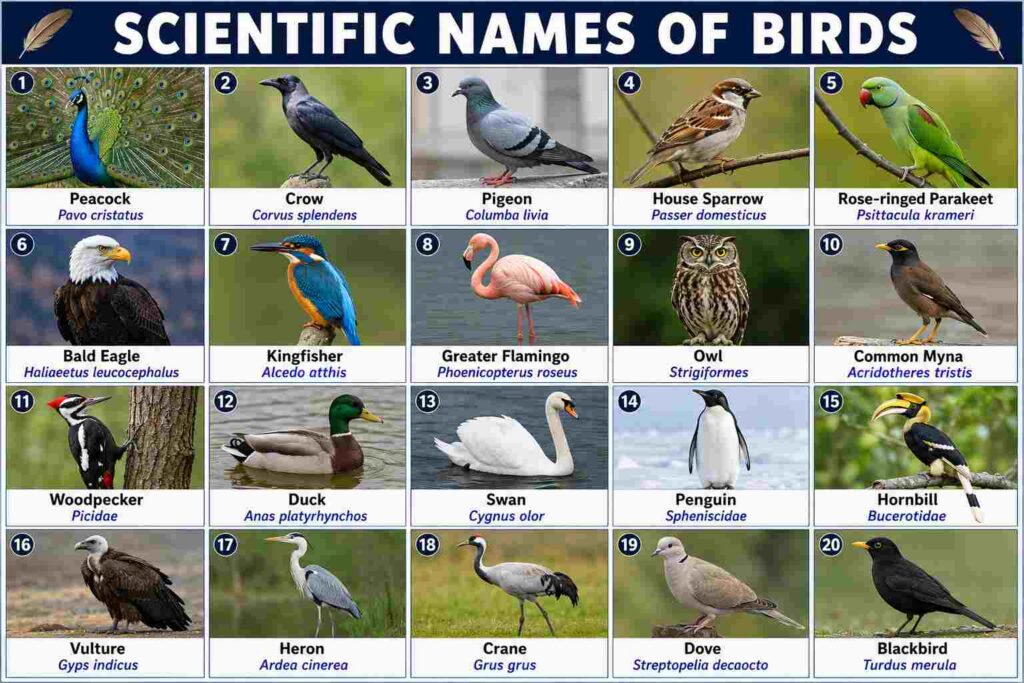
| Peacock (Indian Peafowl) | Pavo cristatus | cristatus = crested (Latin) |
| House Sparrow | Passer domesticus | domesticus = of the house (Latin) |
| Common Crow (House Crow) | Corvus splendens | splendens = shining (Latin) |
| Common Myna | Acridotheres tristis | tristis = sad/mournful (Latin) |
| Rose-ringed Parakeet | Psittacula krameri | Named after zoologist Wilhelm Kramer |
| Indian Roller | Coracias benghalensis | benghalensis = from Bengal (Latin) |
| Common Kingfisher | Alcedo atthis | atthis = a girl from Lesbos (Greek myth) |
| Barn Swallow | Hirundo rustica | rustica = rural/country (Latin) |
| Red Junglefowl | Gallus gallus | Gallus = rooster (Latin) |
| Indian Pigeon (Blue Rock Pigeon) | Columba livia | livia = blue-grey (Latin) |
| Greater Coucal | Centropus sinensis | sinensis = from China (Latin) |
| White-throated Kingfisher | Halcyon smyrnensis | smyrnensis = from Smyrna (Turkey) |
| Coppersmith Barbet | Psilopogon haemacephalus | haemacephalus = blood-headed (Greek) |
| Indian Pied Myna | Gracupica contra | contra = opposite/contrasting (Latin) |
| Red-vented Bulbul | Pycnonotus cafer | cafer = from Caffraria, Africa (Latin) |
| Purple Sunbird | Cinnyris asiaticus | asiaticus = from Asia (Latin) |
| Spotted Owlet | Athene brama | brama = from Brahmin/Indian (Sanskrit) |
| Black Kite | Milvus migrans | migrans = migrating (Latin) |
| Brahminy Kite | Haliastur indus | indus = from India (Latin) |
| Indian Vulture | Gyps indicus | indicus = from India (Latin) |
🦅 Birds of Prey (Raptors)
| Common Name | Scientific Name | Meaning of Name |
|---|---|---|
| Bald Eagle | Haliaeetus leucocephalus | leucocephalus = white-headed (Greek) |
| Golden Eagle | Aquila chrysaetos | chrysaetos = golden eagle (Greek) |
| Peregrine Falcon | Falco peregrinus | peregrinus = wanderer/pilgrim (Latin) |
| Barn Owl | Tyto alba | alba = white (Latin) |
| Great Horned Owl | Bubo virginianus | virginianus = from Virginia (Latin) |
| Snowy Owl | Bubo scandiacus | scandiacus = from Scandinavia (Latin) |
| Osprey | Pandion haliaetus | haliaetus = sea eagle (Greek) |
| Red-tailed Hawk | Buteo jamaicensis | jamaicensis = from Jamaica (Latin) |
| Harris’s Hawk | Parabuteo unicinctus | unicinctus = single-banded (Latin) |
| Secretary Bird | Sagittarius serpentarius | serpentarius = snake-hunter (Latin) |
| Harpy Eagle | Harpia harpyja | Named after Harpies of Greek mythology |
| Philippine Eagle | Pithecophaga jefferyi | pithecophaga = monkey-eater (Greek) |
| Martial Eagle | Polemaetus bellicosus | bellicosus = warlike (Latin) |
| Steppe Eagle | Aquila nipalensis | nipalensis = from Nepal (Latin) |
🦆 Waterbirds & Waders
| Common Name | Scientific Name | Meaning of Name |
|---|---|---|
| Mallard | Anas platyrhynchos | platyrhynchos = flat-billed (Greek) |
| Mute Swan | Cygnus olor | olor = swan (Latin) |
| Whooper Swan | Cygnus cygnus | Named after its whooping call |
| Greater Flamingo | Phoenicopterus roseus | roseus = rose-coloured (Latin) |
| Grey Heron | Ardea cinerea | cinerea = ash-grey (Latin) |
| Great White Egret | Ardea alba | alba = white (Latin) |
| Painted Stork | Mycteria leucocephala | leucocephala = white-headed (Greek) |
| Demoiselle Crane | Anthropoides virgo | virgo = maiden/virgin (Latin) |
| Common Crane | Grus grus | Grus = crane (Latin) |
| Black-necked Stork | Ephippiorhynchus asiaticus | asiaticus = from Asia (Latin) |
| Emperor Penguin | Aptenodytes forsteri | Aptenodytes = wingless diver (Greek) |
| African Penguin | Spheniscus demersus | demersus = plunged under (Latin) |
| Pelican (Great White) | Pelecanus onocrotalus | onocrotalus = ass-bellower (Greek) |
| Gannet (Northern) | Morus bassanus | bassanus = from Bass Rock, Scotland |
| Puffin (Atlantic) | Fratercula arctica | Fratercula = little friar (Latin) |
🐦 Songbirds & Passerines
| Common Name | Scientific Name | Meaning of Name |
|---|---|---|
| Common Nightingale | Luscinia megarhynchos | megarhynchos = large-billed (Greek) |
| American Robin | Turdus migratorius | migratorius = migratory (Latin) |
| European Robin | Erithacus rubecula | rubecula = little red one (Latin) |
| Common Blackbird | Turdus merula | merula = blackbird (Latin) |
| Blue Tit | Cyanistes caeruleus | caeruleus = sky-blue (Latin) |
| Great Tit | Parus major | major = greater (Latin) |
| Common Starling | Sturnus vulgaris | vulgaris = common (Latin) |
| House Finch | Haemorhous mexicanus | mexicanus = from Mexico (Latin) |
| Eurasian Skylark | Alauda arvensis | arvensis = of the fields (Latin) |
| Barn Swallow | Hirundo rustica | rustica = rural (Latin) |
| Java Sparrow | Padda oryzivora | oryzivora = rice-eating (Latin) |
| Common Wren | Troglodytes troglodytes | troglodytes = cave-dweller (Greek) |
| Eastern Bluebird | Sialia sialis | Named from native American languages |
| Baltimore Oriole | Icterus galbula | galbula = little yellow bird (Latin) |
🦜 Parrots & Exotic Birds
| Common Name | Scientific Name | Meaning of Name |
|---|---|---|
| African Grey Parrot | Psittacus erithacus | erithacus = a type of bird (Greek) |
| Scarlet Macaw | Ara macao | macao = from Macau (Portuguese) |
| Blue-and-yellow Macaw | Ara ararauna | ararauna = from native Tupi language |
| Cockatiel | Nymphicus hollandicus | hollandicus = from Holland/Australia (Latin) |
| Sulphur-crested Cockatoo | Cacatua galerita | galerita = crested with a helmet (Latin) |
| Rainbow Lorikeet | Trichoglossus moluccanus | moluccanus = from Moluccas Islands (Latin) |
| Budgerigar | Melopsittacus undulatus | undulatus = wavy/undulating (Latin) |
| Lovebird (Rosy-faced) | Agapornis roseicollis | roseicollis = rosy-necked (Latin) |
| Kakapo | Strigops habroptilus | habroptilus = soft-feathered (Greek) |
| Kea | Nestor notabilis | notabilis = notable/remarkable (Latin) |
🐧 Flightless Birds
| Common Name | Scientific Name | Meaning of Name |
|---|---|---|
| Ostrich | Struthio camelus | camelus = camel (Latin — for its long neck) |
| Emu | Dromaius novaehollandiae | novaehollandiae = from New Holland/Australia (Latin) |
| Cassowary | Casuarius casuarius | From Malay kesuari |
| Rhea | Rhea americana | Named after the Greek Titan Rhea |
| Kiwi (Brown) | Apteryx australis | Apteryx = wingless (Greek) |
| Emperor Penguin | Aptenodytes forsteri | forsteri = named after naturalist Johann Forster |
| Little Penguin | Eudyptula minor | minor = smaller (Latin) |
🌍 National Birds of Countries
| Country | National Bird | Scientific Name |
|---|---|---|
| India | Indian Peacock | Pavo cristatus |
| USA | Bald Eagle | Haliaeetus leucocephalus |
| UK | European Robin | Erithacus rubecula |
| Australia | Emu | Dromaius novaehollandiae |
| New Zealand | Kiwi | Apteryx australis |
| Brazil | Rufous-bellied Thrush | Turdus rufiventris |
| Canada | Common Loon | Gavia immer |
| South Africa | Blue Crane | Anthropoides paradiseus |
| Germany | White Stork | Ciconia ciconia |
| Pakistan | Chukar Partridge | Alectoris chukar |
| Sri Lanka | Sri Lanka Junglefowl | Gallus lafayettii |
| China | Red-crowned Crane | Grus japonensis |
| Japan | Green Pheasant | Phasianus versicolor |
| Russia | Tundra Swan | Cygnus columbianus |
| France | Gallic Rooster | Gallus gallus |
🔬 Endangered & Rare Birds
| Common Name | Scientific Name | Status |
|---|---|---|
| Siberian Crane | Leucogeranus leucogeranus | Critically Endangered |
| Great Indian Bustard | Ardeotis nigriceps | Critically Endangered |
| Philippine Eagle | Pithecophaga jefferyi | Critically Endangered |
| Kakapo | Strigops habroptilus | Critically Endangered |
| Spoon-billed Sandpiper | Calidris pygmaea | Critically Endangered |
| Forest Owlet | Heteroglaux blewitti | Endangered |
| Jerdon’s Courser | Rhinoptilus bitorquatus | Critically Endangered |
| Bengal Florican | Houbaropsis bengalensis | Critically Endangered |
| Sociable Lapwing | Vanellus gregarius | Critically Endangered |
| Christmas Island Frigatebird | Fregata andrewsi | Critically Endangered |
How Bird Scientific Names Are Created
Names often describe appearance, behaviour, habitat, or honour people. Common examples include: migratorius hinting at migration; leucocephalus meaning white-headed; and rustica meaning rural or country-dwelling.
The most common sources of bird scientific name meanings:
| Source | Example | Meaning |
|---|---|---|
| Colour | Ardea alba | alba = white |
| Body part | Haliaeetus leucocephalus | leucocephalus = white-headed |
| Behaviour | Turdus migratorius | migratorius = migratory |
| Habitat | Hirundo rustica | rustica = rural/country |
| Geography | Gyps indicus | indicus = from India |
| Person’s name | Aptenodytes forsteri | forsteri = named after J. R. Forster |
| Sound/call | Alcedo atthis | onomatopoeic origin |
| Greek mythology | Harpia harpyja | Named after the Harpies |
Scientific Names of Birds — Competitive Exam Quick Reference
Most frequently tested across UPSC, SSC, NDA, State PSC, and school biology exams:
| Common Name | Scientific Name |
|---|---|
| Peacock (India’s National Bird) | Pavo cristatus |
| House Sparrow | Passer domesticus |
| Crow (House Crow) | Corvus splendens |
| Common Myna | Acridotheres tristis |
| Pigeon | Columba livia |
| Parrot (Rose-ringed Parakeet) | Psittacula krameri |
| Bald Eagle | Haliaeetus leucocephalus |
| Barn Owl | Tyto alba |
| Ostrich | Struthio camelus |
| Flamingo | Phoenicopterus roseus |
| Peacock | Pavo cristatus |
| Kingfisher | Alcedo atthis |
| Nightingale | Luscinia megarhynchos |
| Emu | Dromaius novaehollandiae |
| Emperor Penguin | Aptenodytes forsteri |
| Mallard (Duck) | Anas platyrhynchos |
| Swan | Cygnus olor |
| Indian Roller | Coracias benghalensis |
| Great Indian Bustard | Ardeotis nigriceps |
| Red Junglefowl | Gallus gallus |
Frequently Asked Questions
What is the scientific name of birds as a class?
The scientific name for all birds as a class is Aves. Every bird species on Earth belongs to Class Aves, which is further divided into Orders (ending in -iformes), Families (ending in -idae), Genus, and Species.
Who invented the scientific naming system for birds?
The binomial nomenclature system used to name birds was invented by Carl Linnaeus, a Swedish botanist and zoologist. Scientific names are created using a system called binomial nomenclature, which includes the genus name followed by the species name. Linnaeus formally published his system in Systema Naturae in 1758 for animals, including birds.
What is the scientific name of the Peacock?
The scientific name of the Indian Peacock — India’s national bird — is Pavo cristatus. Pavo is the Latin word for peacock, and cristatus means crested, referring to the peacock’s iconic crown of feathers.
What is the scientific name of the House Sparrow?
The scientific name of the House Sparrow is Passer domesticus. Passer means sparrow in Latin, and domesticus means of the house or domestic — reflecting the bird’s close association with human settlements worldwide.
What is the scientific name of the Eagle?
The most well-known eagle scientific names are: Bald Eagle — Haliaeetus leucocephalus (white-headed sea eagle); Golden Eagle — Aquila chrysaetos (golden eagle in Greek); and Indian/Steppe Eagle — Aquila nipalensis (from Nepal). Aquila is Latin for eagle and is one of the most recognisable bird genera globally.
Can scientific names of birds change?
Yes, names can change when scientists discover new information about a bird’s classification or genetic relationships. Recent American Ornithological Society decisions are phasing out eponymous names tied to problematic histories in favour of descriptive ones, reflecting broader efforts toward equity and clarity. DNA analysis has also led to significant reclassifications in recent decades.
What is the scientific name of the Ostrich?
The scientific name of the Ostrich is Struthio camelus. Struthio comes from the Greek word for ostrich, and camelus means camel in Latin — a reference to the ostrich’s long neck and ability to survive in arid desert conditions similar to a camel’s habitat.
How many bird species exist in the world?
As of 2026, scientific databases like Avibase track approximately 10,000 to 11,000 living species of birds. However, recent morphological and genetic studies suggest that if we redefine species based on evolutionary lineages, that number could be as high as 18,000 to 20,000.
What is the scientific name of the Owl?
Different owl species have different scientific names. The Barn Owl is Tyto alba (alba = white). The Great Horned Owl is Bubo virginianus (from Virginia). The Snowy Owl is Bubo scandiacus (from Scandinavia). The Spotted Owlet found across India is Athene brama (brama from the Sanskrit reference to Brahmin/India).
Why are bird scientific names written in Latin or Greek?
All birds have a scientific name — actually two names — derived primarily from Latin or Greek. Latin was the universal language of science and scholarship when Linnaeus established the naming system in the 18th century. Being a dead language, Latin meanings remain fixed over time — unlike living languages where words change meaning — ensuring bird scientific names remain stable and universally understood across all countries and centuries.
Final Thoughts
Scientific names of birds are the universal passport of ornithology — giving every one of the world’s 10,000+ bird species a unique, precise, and permanent identity that transcends language, geography, and time. From the iconic Pavo cristatus displaying its crown in an Indian garden to the critically endangered Ardeotis nigriceps fighting for survival on the Rajasthan plains, every scientific name tells a story about a bird’s appearance, behaviour, habitat, or discovery history.
Learning these names helps with accurate bird identification, education, research, and understanding biodiversity. From forests to oceans, every species has its own unique identity. Once you understand the system — genus reveals the family, species identifies the individual, italics signal the scientific name — reading and remembering these names becomes second nature.
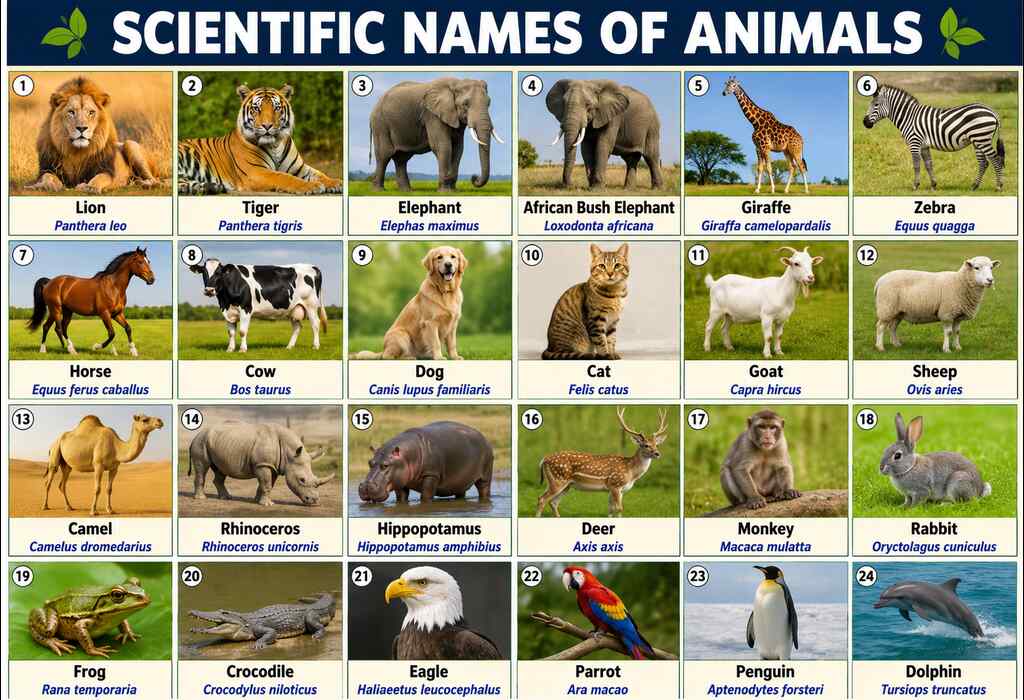
Explore more: Scientific Names of Animals · Scientific Names of Plants · Binomial Nomenclature Rules & Examples
Word Count: ~2,000 words Reading Level: Grade 7–8 Schema: Article + FAQPage Target Audience: Students (Class 6–12), UPSC/SSC/NDA aspirants, birdwatchers, ornithology enthusiasts Internal Links: 3 placeholders Image Alt Tag: “Scientific names of birds chart — binomial nomenclature list with common and Latin names of birds”